Letter S Organizer 3D Print STL 3D: A Strategic Guide for Creators and Small Business Owners
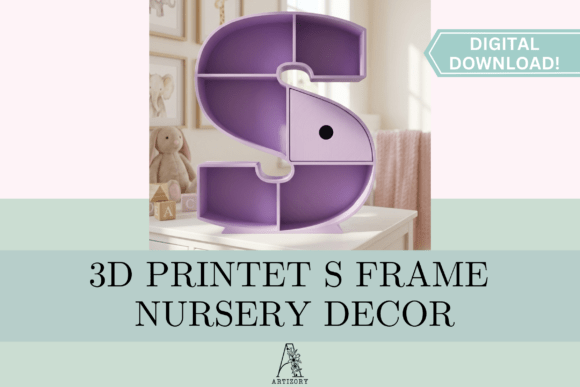
The intersection of personalized decor and functional storage has never been more profitable or visually appealing. For small business owners, educators, and hobbyists looking to expand their product catalog, the Letter S Organizer 3D Print STL 3D represents a significant opportunity. This specific design is not merely a novelty item; it is a carefully engineered component of a larger, functional alphabet series. It combines the aesthetic appeal of a monogram with the practical utility of a drawer-based cubby system.
However, success in this niche requires more than just downloading a file and hitting "print." Many creators overlook the nuances of FDM printing optimization, material selection, and post-processing, leading to products that fail to meet customer expectations. This guide explores the realities of producing high-quality Letter S organizers, highlighting common pitfalls and offering practical advice to ensure your final product is sturdy, sleek, and ready for sale.
Understanding the Design and Its Market Appeal
At its core, the Letter S Organizer is a shelf unit shaped like the letter "S," featuring an integrated drawer. The clean, modern aesthetic appeals to a broad demographic, from parents seeking nursery organization to professionals desiring minimalist desk accessories. Because it is part of a functional alphabet series, it allows for customization. Customers can order initials for names, birthdays, or branding purposes, making it a versatile gift option.
For entrepreneurs, the value proposition is clear. You are offering a solution to clutter while providing a decorative element. The design is optimized for standard 25x25 cm print beds, which means you do not need industrial-sized printers to produce these units. This accessibility lowers the barrier to entry, allowing freelancers and small studios to start offering premium 3D printed goods without massive capital investment.
Common Mistakes in Printing and Post-Processing
While the file is described as having minimal support requirements, assuming that "minimal" means "none" is a critical error. The only supports required are for the drawer handle. If you ignore this requirement, the handle will likely fail during printing or detach prematurely, rendering the organizer useless. Conversely, if you over-support the entire model, you risk damaging the delicate geometry of the "S" curves during removal.
Mistake 1: Ignoring Layer Orientation and Strength
FDM (Fused Deposition Modeling) prints have varying strengths depending on layer orientation. A common misunderstanding is that any orientation works equally well. In reality, printing the Letter S vertically might result in weak inter-layer adhesion along the curve, causing the piece to snap under the weight of stored items. To ensure structural integrity, consider how the layers align with the stress points of the drawer mechanism. Proper orientation ensures the organizer remains sturdy enough for real-world use, rather than becoming a fragile display piece.
Mistake 2: Overlooking Tolerance and Fit
A functional drawer requires precise tolerances. If the gap between the drawer and the main body is too tight, friction will prevent smooth operation. If it is too loose, the drawer will wobble, compromising the sleek, minimalist look. Beginners often assume that default slicer settings will yield perfect fits. However, filament shrinkage and printer calibration play huge roles. Always test-print the drawer component separately before assembling the full Letter S unit. Adjusting horizontal expansion or scale by fractions of a millimeter can mean the difference between a professional finish and a frustrating user experience.
Mistake 3: Neglecting Surface Finish Expectations
Customers purchasing personalized decor expect a polished appearance. Raw FDM prints often show visible layer lines. While some buyers appreciate the "maker" aesthetic, most will expect a smoother surface for a product marketed as a modern home accessory. Failing to address this leads to negative reviews and returns. It is essential to manage customer expectations regarding the nature of FDM printing or invest time in post-processing techniques such as sanding, priming, or painting.
Best Practices for Production Quality
To avoid the pitfalls mentioned above, adopt a systematic approach to production. Start by verifying the file’s integrity. Ensure that the STL file is watertight and free of non-manifold edges. Most slicers will warn you about these issues, but ignoring them can lead to failed prints or poor quality surfaces.
- Optimize Support Placement: Since only the drawer handle needs support, use tree supports or custom supports specifically targeted at this area. This minimizes material waste and reduces the risk of scarring the rest of the Letter S surface.
- Select the Right Material: PLA is popular for its ease of use and crisp detail, making it ideal for the clean lines of this organizer. However, for items that may face heat or heavy loads, consider PETG or ABS for greater durability. For a nursery setting, PLA is generally safe and sufficient, provided the printer is calibrated correctly.
- Calibrate Your Printer: Before running a batch of orders, perform a calibration cube test. Check for dimensional accuracy, especially in the drawer slide mechanism. Consistent results are key to building a reputable brand.
Evaluating the File for Your Business Needs
Before committing to selling the Letter S Organizer, evaluate whether this file aligns with your capabilities. Ask yourself: Do I have the time to handle post-processing? Can I consistently achieve the necessary tolerances? If you are new to 3D printing, start with a single unit to test the workflow. This helps you estimate production time accurately, ensuring your pricing reflects the labor involved in assembly and finishing.
Furthermore, consider the scalability. Since this is part of an alphabet series, think about bundling options. Offering a complete set of initials or name-building blocks can increase average order value. However, ensure that each letter maintains consistent design language and printability. The Letter S STL is designed for efficiency, but consistency across all 26 letters is what creates a cohesive product line.
Final Thoughts on Execution
The Letter S Organizer 3D Print STL 3D is more than just a file; it is a tool for creating value. By understanding the technical requirements—such as support placement, tolerance adjustment, and material choice—you can transform a digital model into a tangible, high-quality product. Avoid the trap of rushing production. Take the time to refine your process, test your outputs, and deliver a product that meets the high standards of modern consumers.
Whether you are printing a single gift or scaling up for a busy season, focus on the details. A well-fitted drawer, a smooth surface, and a sturdy structure will speak louder than any marketing copy. By adhering to these practical guidelines, you position yourself not just as a seller of 3D prints, but as a provider of reliable, stylish organizational solutions.